
How we scored it
Pionex is an exchange built around trading automation rather than a normal exchange with bots added later. Its 0.05% spot fee is excellent, but the Growth Fund is not withdrawable cash and its visible reserve report is years out of date.
- Cost
- Maker fee
- 0.050%
- Sign-up offer
- Growth Fund tasks advertised up to 10,000 USDT; promotional principal cannot be withdrawn.
- Trading
- Products
- spot, perp, bots, earn
- Access
- Identity verification
- tiered
- Fiat deposits
- Yes
- Company
- Founded
- 2019
- Headquarters
- Entity varies by product
- Proof of reserves
- Not published
The first support response arrived in 1 to 2 minutes in our own logged-in account test. The score reflects that measured response speed; it does not claim every future case will resolve that quickly.
- The bot toolkit is the product, not an afterthought. Grid, Martingale DCA, Rebalancing, TWAP, Futures Grid, Signal and specialist grid builders are integrated into the exchange.
- Regular spot trading costs 0.05% maker and taker. A complete $10,000 round trip costs $10 before spread, half the fee at many large exchanges.
- 942 tradable markets in the public catalogue: 335 enabled spot pairs and 607 perpetual instruments marked TRADING at our verification timestamp.
- Builders expose the real controls. Range, grids, safety orders, leverage, direction, margin and exits can be inspected before committing capital.
- Network costs are unusually transparent. BTC, USDT and ETH minimums and withdrawal fees are published together in a live table.
- Deposits credited in seconds to a few minutes, withdrawals completed in 2 to 60 minutes, and support answered in 1 to 2 minutes, all measured through our own account.
- The 10,000 USDT headline is Growth Fund, not cash. The promotional principal cannot be withdrawn and normally expires after a short period.
- The visible proof-of-reserves evidence is stale. The linked procedures report assessed a snapshot from December 2022 and covered 79.60% of platform liabilities.
- AI strategy APRs are short backtests annualised into enormous numbers. The live builders showed figures above 2,000% beside seven-day windows.
- DCA means Martingale here. It adds as price moves against the position; that is materially different from buying a fixed amount on a calendar.
- The product and operator change by region. Pionex Global, Pionex.US and Webot cannot be treated as the same exchange.
- Realised bot behaviour remains untested by us. We will not infer profitability from a polished builder or an annualised backtest.
Pionex is one of the few exchanges where the bots are good enough to justify choosing the venue. The regular global spot fee is 0.05%, the builders expose meaningful controls, and the public catalogue returned 942 tradable spot and perpetual instruments when we checked. The catch is trust evidence: its reward headline is not withdrawable cash, its regional products are easy to confuse, and the reserve report it still points users toward is old.
What this review actually tested
We opened the logged-in global product and inspected every bot entry exposed on the web interface. We also checked the rewards hub, fees, KYC limits, withdrawal-network table, Earn products, security settings, public market API, current terms and regional regulatory records. In a separate hands-on support test, the first response arrived in 1 to 2 minutes.
We also moved real money through the account: deposits credited in seconds to a few minutes and withdrawals completed in 2 to 60 minutes across the tested chains. We did not fund a bot during this pass. Screenshots prove what the interface offered and what settings it displayed; they do not prove that a strategy is profitable.
Pionex Global, Pionex.US and Webot are different products
The name on the page is not enough to tell you which company holds the account. Pionex Global’s terms name Marketa Trading Inc. and exclude the United States, United Kingdom, Canada, Netherlands, Spain and France among other jurisdictions. Its bot and derivatives catalogue is the product shown throughout most of this review.
The US agreement names Pionex Inc., a Delaware company. That business now presents itself as Webot, formerly Pionex US, and publishes a separate licence list and fee schedule. Its product should not be described using the Global market count or fee table.
The European Webot product is another route again. Pionew Ireland Limited appears in the ESMA register under the Webot trade name, authorised for custody, operation of a trading platform, exchange and transfer services. That authorisation belongs to the Irish company and Webot product. It is not a blanket licence for Pionex Global.
| Product | Named operator | Important consequence |
|---|---|---|
| Pionex Global | Marketa Trading Inc. | Full product reviewed here; long restricted-country list |
| US/Webot | Pionex Inc. | US-specific licences, availability, bots and fees |
| EU/Webot | Pionew Ireland Limited | MiCA-authorised regional product with its own terms |
What new users actually receive
The large 10,000 USDT figure is a Growth Fund ceiling, not a cash signup bonus. The live hub split the attainable beginner missions into much smaller amounts: 10 USDT for signup, 15 USDT for identity verification, 10 to 50 USDT for a qualifying first deposit, and 15 to 50 USDT for a qualifying manual futures trade.

The first deposit mission required at least 50 USDT or the USDC equivalent in the screen we captured. The futures mission required an initial transfer of at least 100 USDT to the futures account plus a manual futures trade. Its payout was random within the displayed range and the task carried a countdown.
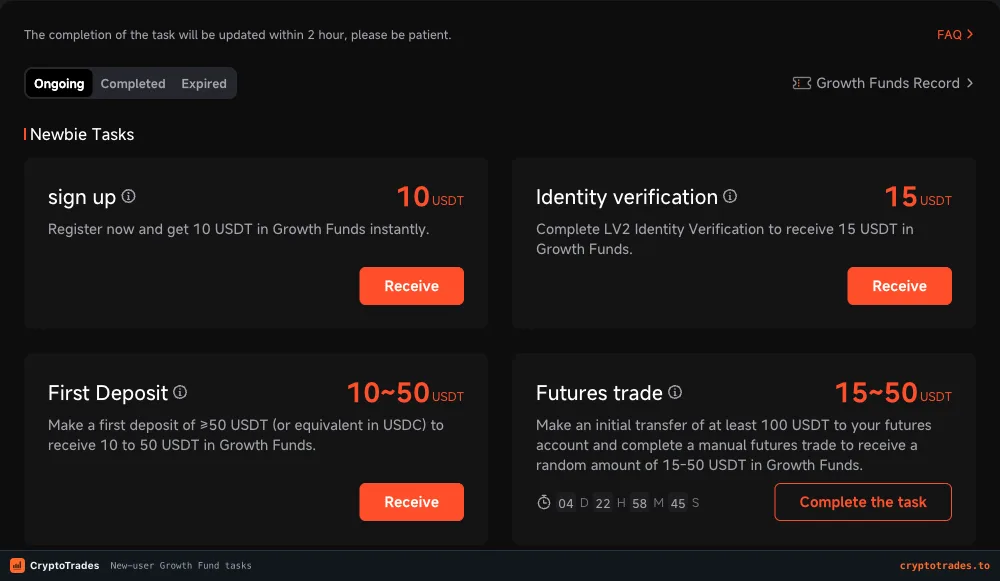
Growth Fund cannot be withdrawn
Pionex reclaims the promotional principal. Its rules say Growth Fund is automatically placed into a designated arbitrage or flexible Earn product, normally remains valid for five to seven days, and cannot be moved into spot or futures trading. Profit generated during that period is distributed to the main account and can then be used or withdrawn.
That makes a 50 USDT Growth Fund fundamentally different from a 50 USDT account credit. The economic value is only the short period of yield generated by the fund. If 50 USDT earned even a very high 10% annualised rate for seven days, the result would be about ten cents, not 50 dollars.
The limited mission we saw offered 25 USDT in Growth Fund for inviting users, plus commission. Separate promotions advertised daily trading credit and prizes. Both had expiry counters.
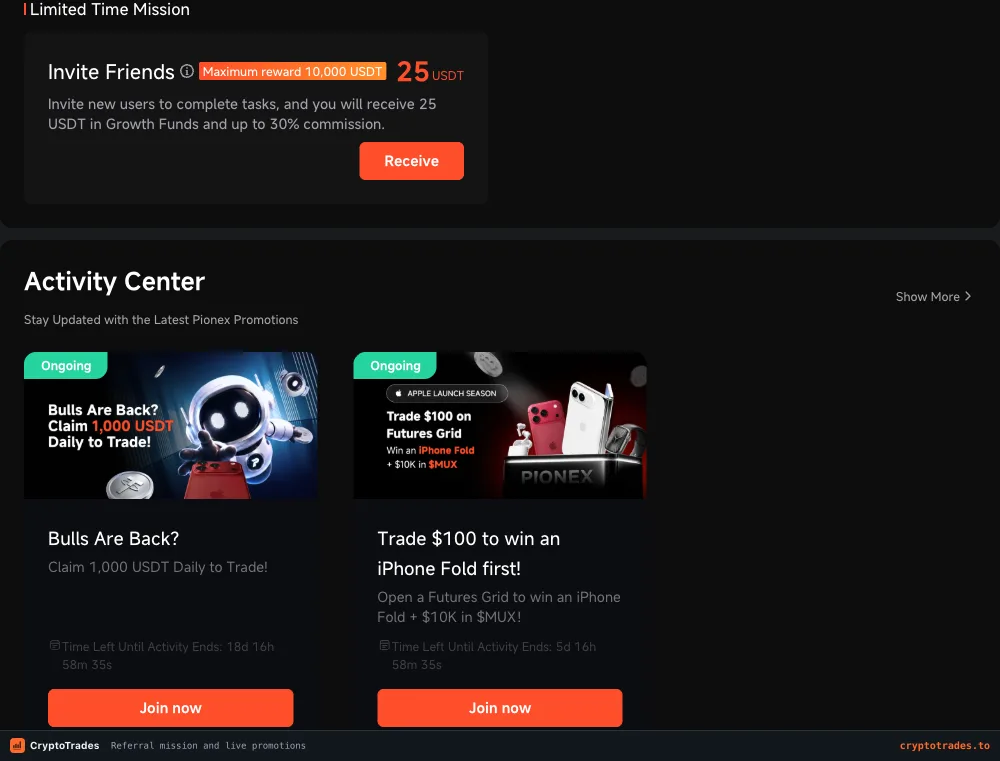
What Pionex trading fees cost
Regular global spot trading costs 0.05% on both sides. Buying 10,000 USDT of an asset costs 5 USDT, and selling the same notional costs another 5 USDT. The complete round trip is therefore 10 USDT before spread and slippage.
Perpetuals use a 0.02% maker and 0.05% taker rate. A 10,000 USDT position opened and closed as taker costs 10 USDT in trading fees. Posting both sides costs 4 USDT if both orders actually receive maker treatment. Funding is separate and can exceed the trading fee on a position held through repeated settlements.
Leveraged tokens were shown at 0.10% maker and taker. They also carry product-specific mechanics that are not captured by the trade fee alone.
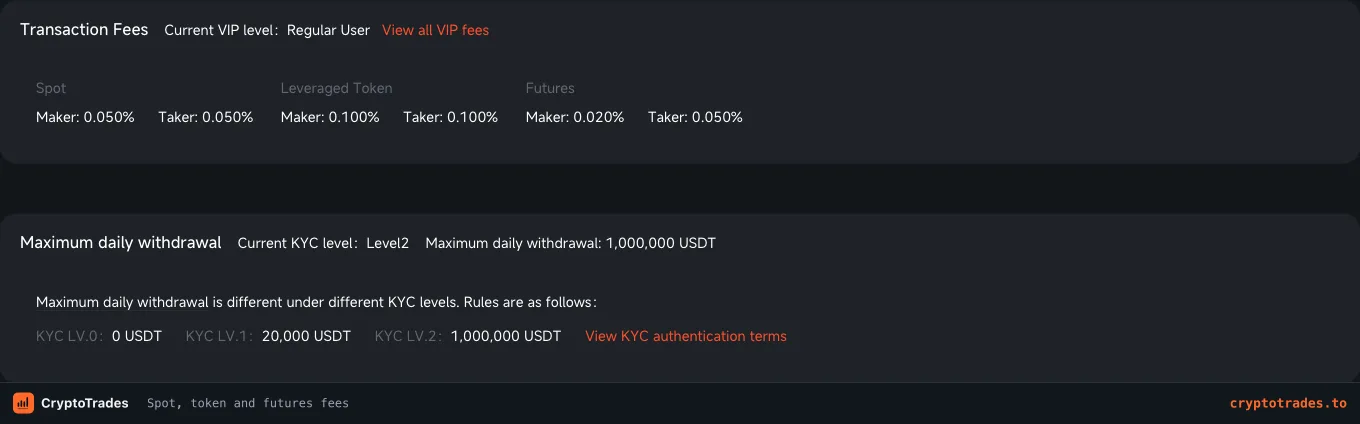
How many markets Pionex actually lists
The public catalogue returned 335 enabled spot pairs and 607 perpetual instruments marked TRADING. The spot response contained 407 records in total, but 72 were disabled. The live ticker feed is narrower and changes continuously: our latest completed collection cycle received prices for 325 spot and 606 perpetual markets. The review card and market table use that collected, price-bearing count rather than pretending every catalogue row traded in the same cycle.
The market page sorts spot listings by quote currency and theme, including tokenized stocks, new listings, AI, layer-one, layer-two, DeFi and meme assets. It also publishes price, fiat equivalent, volume and daily change in one table.
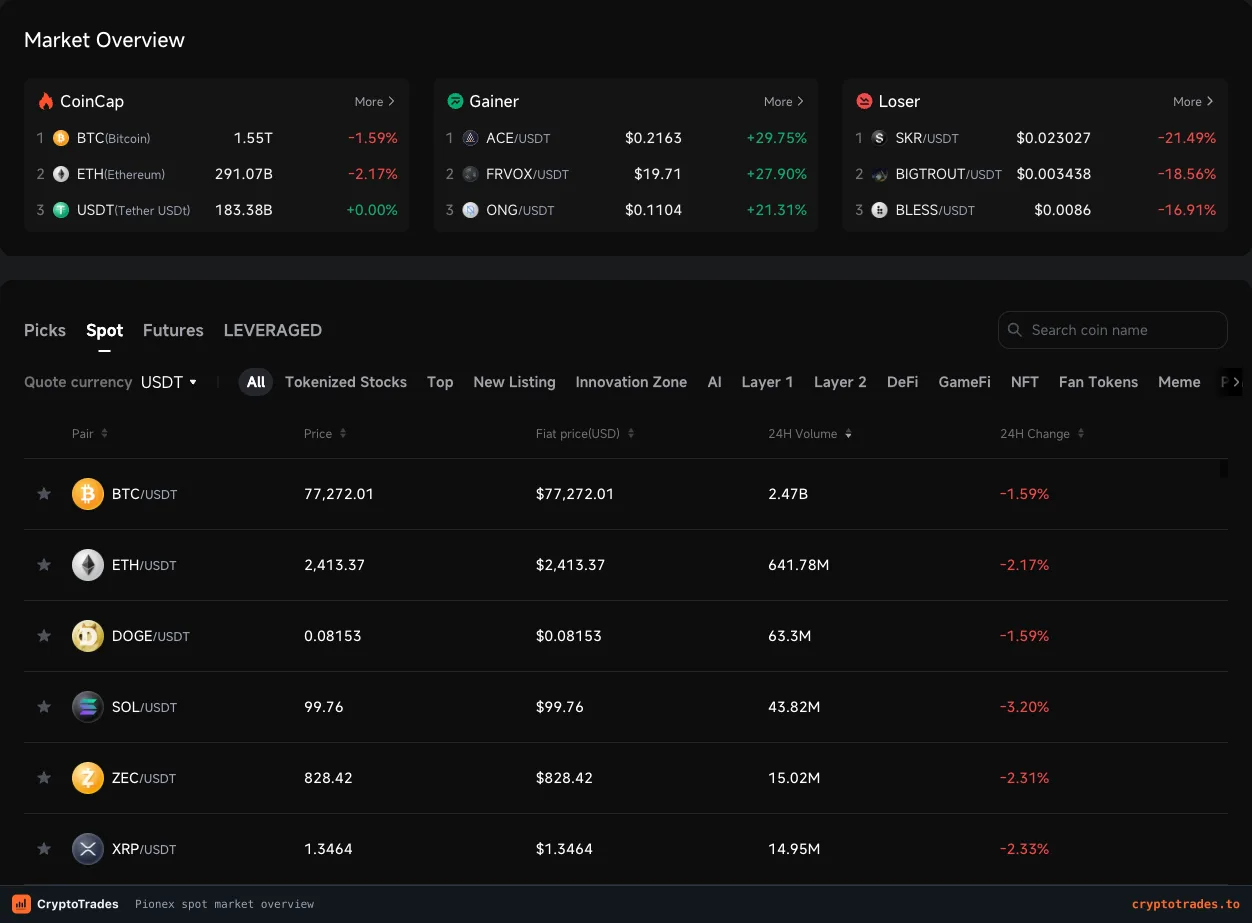
Market count is not liquidity. The BTC screens displayed large headline volume and active order books, but we have not yet run fixed-size depth and slippage tests across major and mid-cap pairs. The liquidity score reflects breadth and visible major-market activity, not a completed execution benchmark.
Which Pionex bots are available
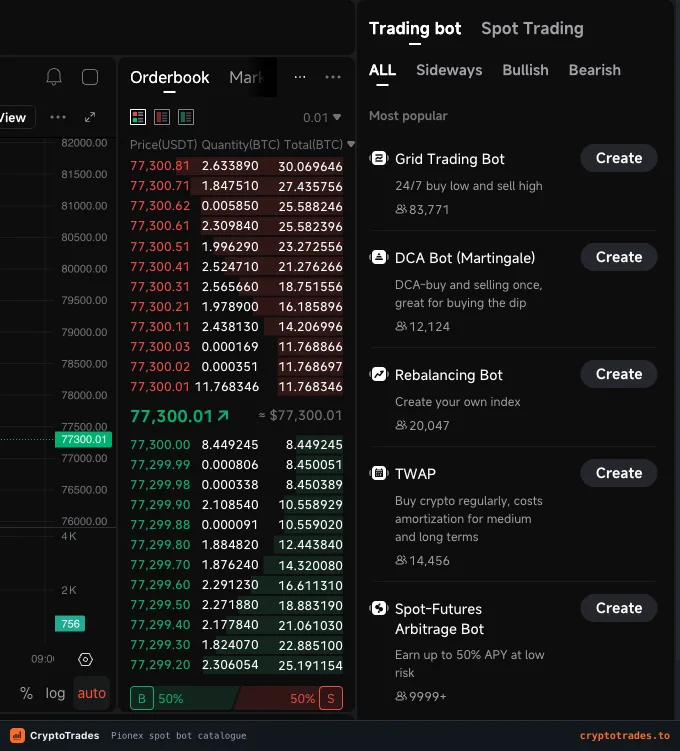
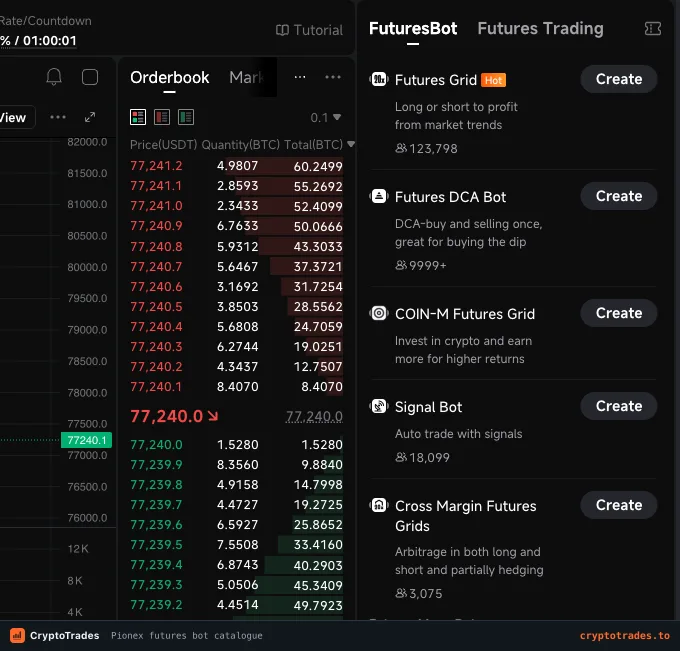
The live web interface does not reduce cleanly to the marketing phrase “16 bots.” The spot screen exposed 12 entries, while the futures screen exposed nine. Some are full portfolio strategies, some are specialised grid variants, and some are automated order types. Several overlap with the 16 names in Pionex’s separate bot finder.
The spot catalogue included Grid, Martingale DCA, Rebalancing, TWAP, spot-futures arbitrage, Margin Grid, Reverse Grid, Infinity Grid, Smart Trade, Trailing Sell, Trailing Buy and Stop Limit. Stop Limit now points users to Manual Trading rather than opening a separate bot builder.
The futures catalogue included Futures Grid, Futures DCA, COIN-M Futures Grid, Signal Bot, Cross Margin Futures Grids and four Moon or Growth variants promoted as high-frequency arbitrage with zero fees.
How the Spot Grid Bot works
Spot Grid places alternating limit orders inside a fixed price range. The builder asks for a lower limit, upper limit, number of grids and total investment. More grids create more potential executions but reduce gross profit per grid. Fewer grids widen the interval and require a larger move before the next order fills.
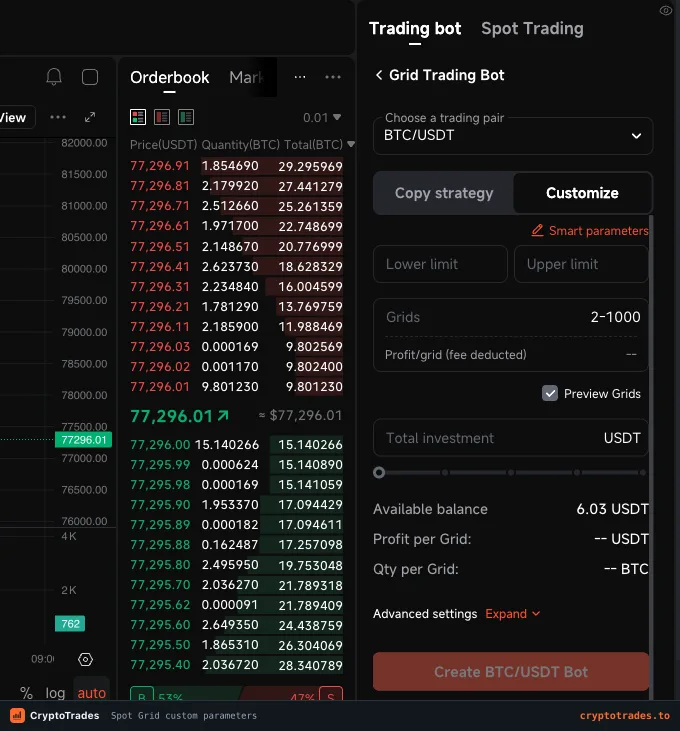
The strategy works best when price repeatedly crosses grid levels without escaping the configured range. Above the upper limit, the bot has sold progressively more of the base asset and stops finding higher grid orders. Below the lower limit, it has bought progressively more and can end fully exposed to the falling asset.
Grid profit is not total profit. A bot can report completed profitable grid trades while the unsold inventory has an unrealised loss larger than all grid gains. The useful equation is:
total result = realised grid profit + inventory change - trading fees
At 0.05% per fill, a buy and later sell consume roughly 0.10% before spread. A grid interval offering 0.12% gross leaves almost nothing. The builder’s fee-deducted profit estimate is therefore more useful than the number of grids.
Why Pionex DCA is a Martingale strategy
Pionex uses DCA to mean a position that adds as price moves against it, then exits the cycle around a target profit. That is not the same as buying 100 dollars of Bitcoin every month regardless of price.
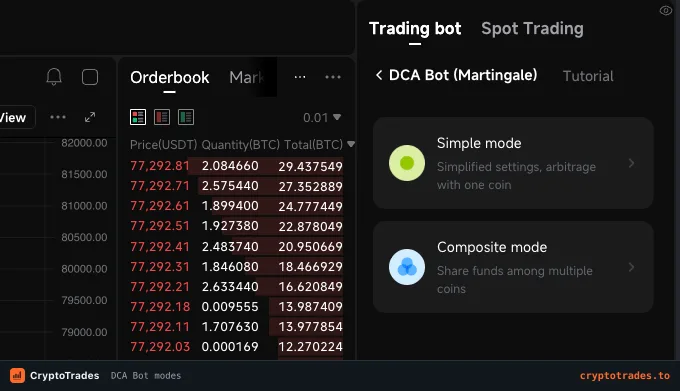
The web entry offered Simple mode for one coin and Composite mode for several coins sharing funds. The deeper settings control price deviation, take-profit ratio, number of safety orders and volume scale. Volume scale determines how quickly later orders become larger than the first.
Suppose the first order is 10 USDT and the volume scale is 1.5. Eight orders require 10, 15, 22.50, 33.75, 50.63, 75.94, 113.91 and 170.86 USDT before fees. The last order is seventeen times the first and total committed capital is almost 493 USDT. That growth is the defining risk.
The strategy can recover quickly from ordinary pullbacks because the average entry falls. It fails when the asset keeps falling, the safety-order ladder runs out or several Composite positions demand capital together. Use it only with a maximum allocation known in advance.
What the Rebalancing Bot does
Rebalancing maintains chosen portfolio weights by selling relative winners and buying relative losers. The builder starts with either an index pool or a custom basket.
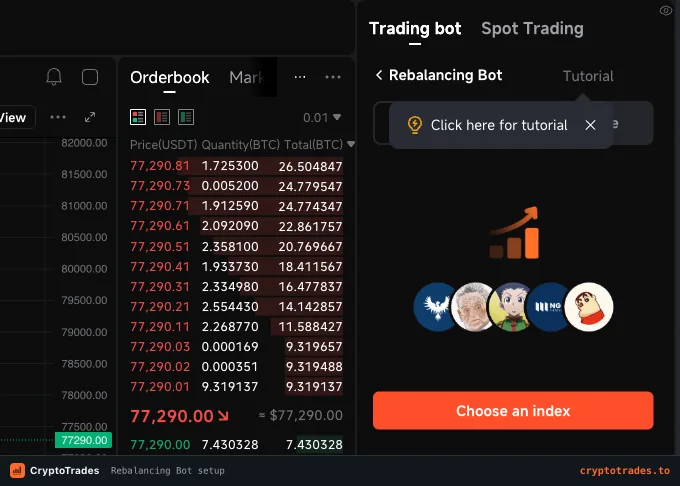
It is useful when the investment thesis is about a basket rather than one asset. Rebalancing can harvest relative movement between components. It cannot protect the portfolio when every component falls together, and frequent rebalancing adds fees and taxable events where applicable.
The review will not claim a universal minimum because the required investment follows the assets, weights and order minimums selected in the builder.
How Margin Grid differs from Spot Grid
Margin Grid borrows to increase grid exposure. The live builder offered long and short modes plus AI strategy cards with 3x and 5x examples. Cards displayed a backtest window, upper and lower limits, leverage, annualised grid return and trailing percentage.
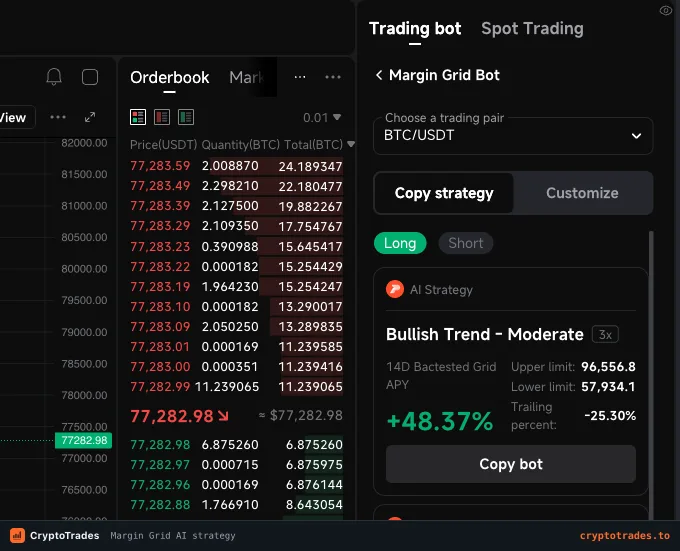
Borrowing changes the loss path. A normal spot grid below its range owns the base asset. A long Margin Grid owns more exposure than the deposited capital supports and pays borrowing costs. A short version has the opposite directional risk. The grid can still realise small profitable trades while the leveraged inventory moves toward forced closure.
The builder showed a 14-day annualised return on the first card. That is a backtest statistic, not money earned for a year. Range, leverage and trailing percent deserve more attention than the large green percentage.
Reverse Grid and Infinity Grid solve different problems
Reverse Grid measures success in the base asset; Infinity Grid removes the fixed upper boundary. Neither is a safer version of Spot Grid.
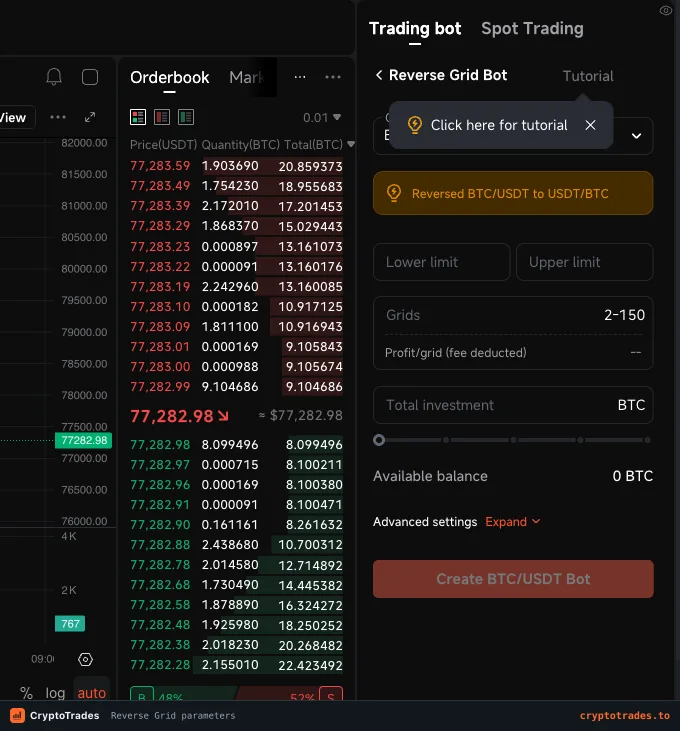
Reverse Grid is for someone who already holds the base asset and wants to sell pieces higher, then buy them back lower. The builder reverses the pair representation and takes investment in BTC for BTC/USDT. A rising market that never retraces can leave the bot with less BTC than simply holding.
Infinity Grid follows a rising market without a fixed upper limit by moving the effective grid upward. The builder exposed a lower limit and profit-per-grid percentage, with AI parameters that could be copied into manual settings.
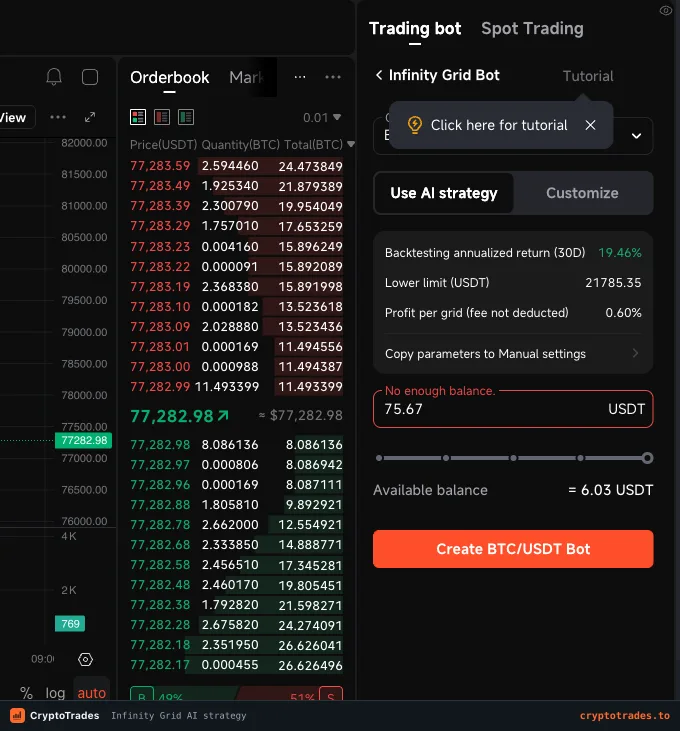
Removing the ceiling helps retain exposure in a long rise. It does nothing to prevent losses below the lower limit. It can also trail a simple buy-and-hold position during a one-way rally because repeated sales continually reduce exposure.
Futures Grid adds funding and liquidation
Futures Grid applies the grid mechanism to perpetual contracts with long, short or neutral direction and leverage. The AI cards we observed used 5x, 10x and 15x examples and annualised short-window backtests.
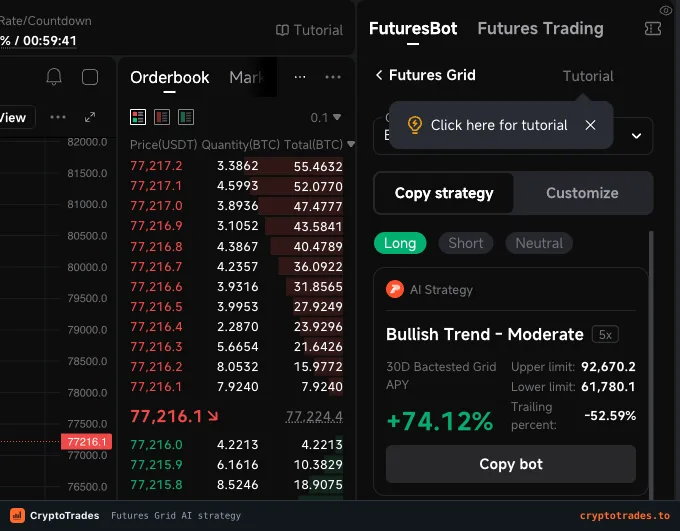
Long grids profit from oscillation with positive exposure. Short grids invert the direction. Neutral grids place both sides but are not directionless once orders fill. All three add perpetual funding, mark-price liquidation and margin management to ordinary grid risk.
The dangerous reading is “more grids mean more profit.” More leveraged grids mean more fills, more fees and a denser position ladder. If the market crosses the range in one direction, the bot can accumulate exposure faster than the trader expects.
Futures DCA compounds the Martingale risk
Futures DCA combines staged adding with leverage. The current web builder offered long and short direction, Copy Strategy, Customize and DIY modes. This directly contradicts an official help article that still describes the product as app-only.
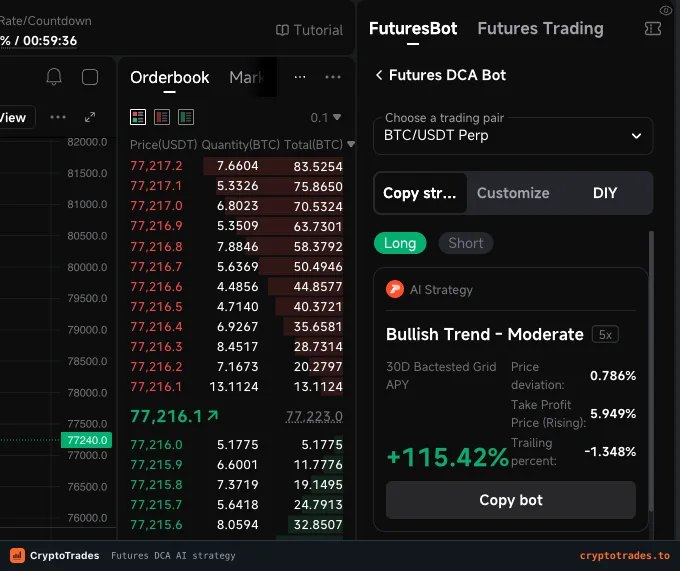
The first AI card displayed a 30-day backtest. More aggressive cards used shorter windows and produced annualised figures above 2,000%. That number is mathematically possible as an annualisation and practically useless as a forecast.
The failure mode is plain: each addition increases a leveraged losing position. Margin can be added, but adding margin changes the amount at risk rather than repairing the trade. Futures DCA belongs in the high-risk category even when the interface calls a preset moderate.
Cross Margin Futures Grids share the failure pool
Cross Margin Futures Grids can open long and short grids that share extra margin. The builder allowed one or both grids, then calculated a combined investment and estimated liquidation price.
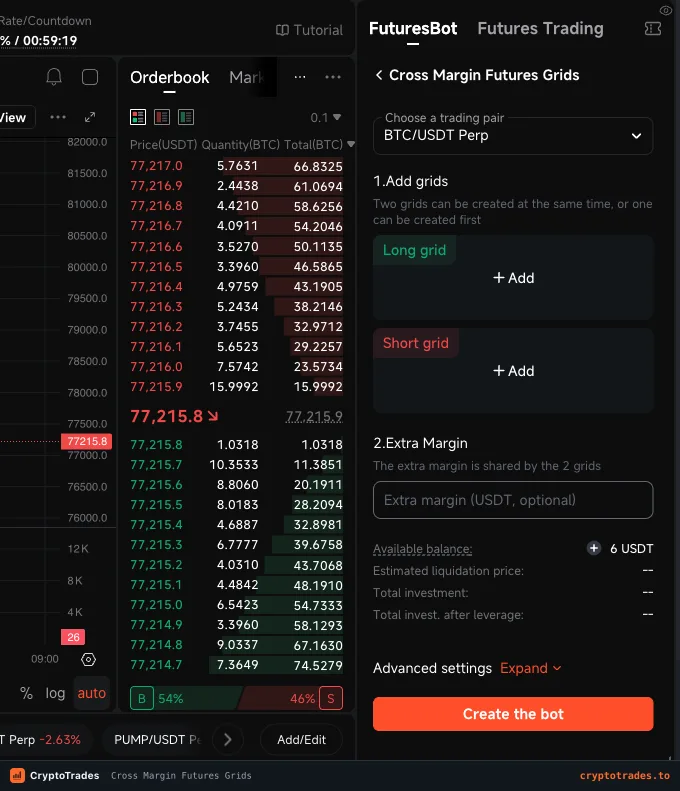
Opposing grids can reduce net direction for a period, but they are not free arbitrage. Both sides trade, both pay fees, perpetual funding can differ, and one side can grow while the other repeatedly closes small profits. Cross margin also means a problem in one grid can consume capital supporting the other.
This is a portfolio margin tool for someone already comfortable reading mark price, liquidation and funding. It is not a beginner hedge button.
What Signal Bot, TWAP and trailing tools add
These are execution automations rather than return-generating strategies by themselves. Signal Bot receives supported external signals, including custom TradingView signals, and turns them into futures orders. The signal source still determines whether the trade is good.
TWAP divides a larger order across time. The live builder offered Limited mode, which stops after a defined number of executions, and Perpetual mode, which continues until stopped. It reduces timing impact but does not guarantee a better average price.
Smart Trade combines entry, take profit, trailing take profit and stop loss. Trailing Buy and Trailing Sell wait for a reversal by the configured percentage after a trigger. They are useful order logic. Calling them bots does not create an edge.
What Pionex Earn rates mean
The Earn page offered flexible products that compound hourly, but every displayed APR is variable. The screen listed 112 supported cryptocurrencies and showed different rates for USDT, BTC, ETH and other assets.
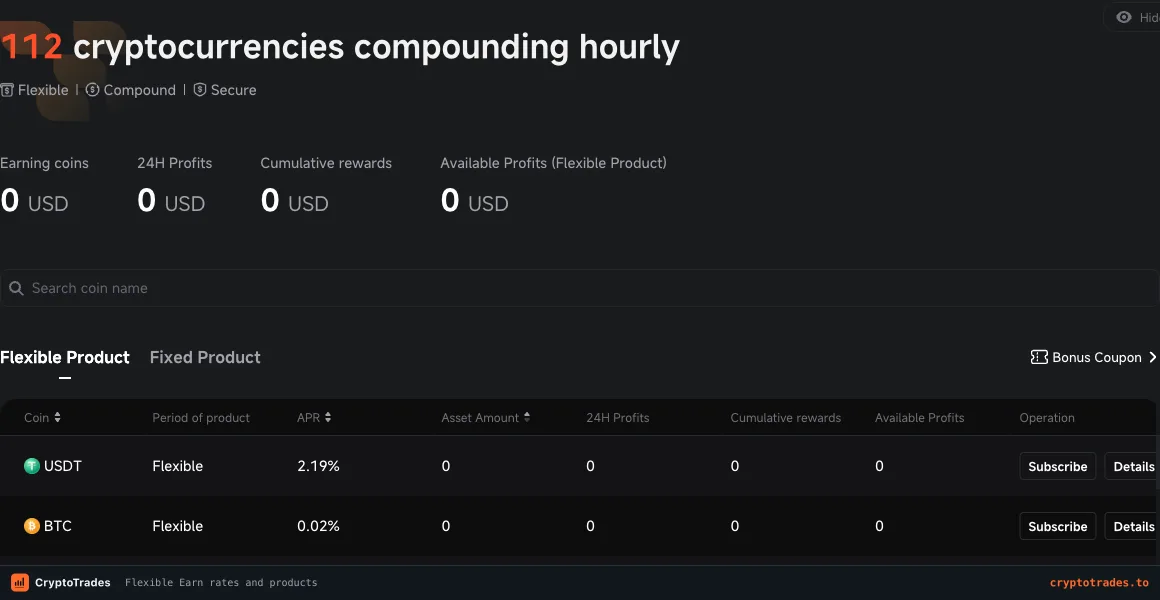
The separate USDT flexible-arbitrage page displayed a current 24-hour APR and a next estimated APR. Those two columns differed, which is the clearest possible warning that the rate moves.
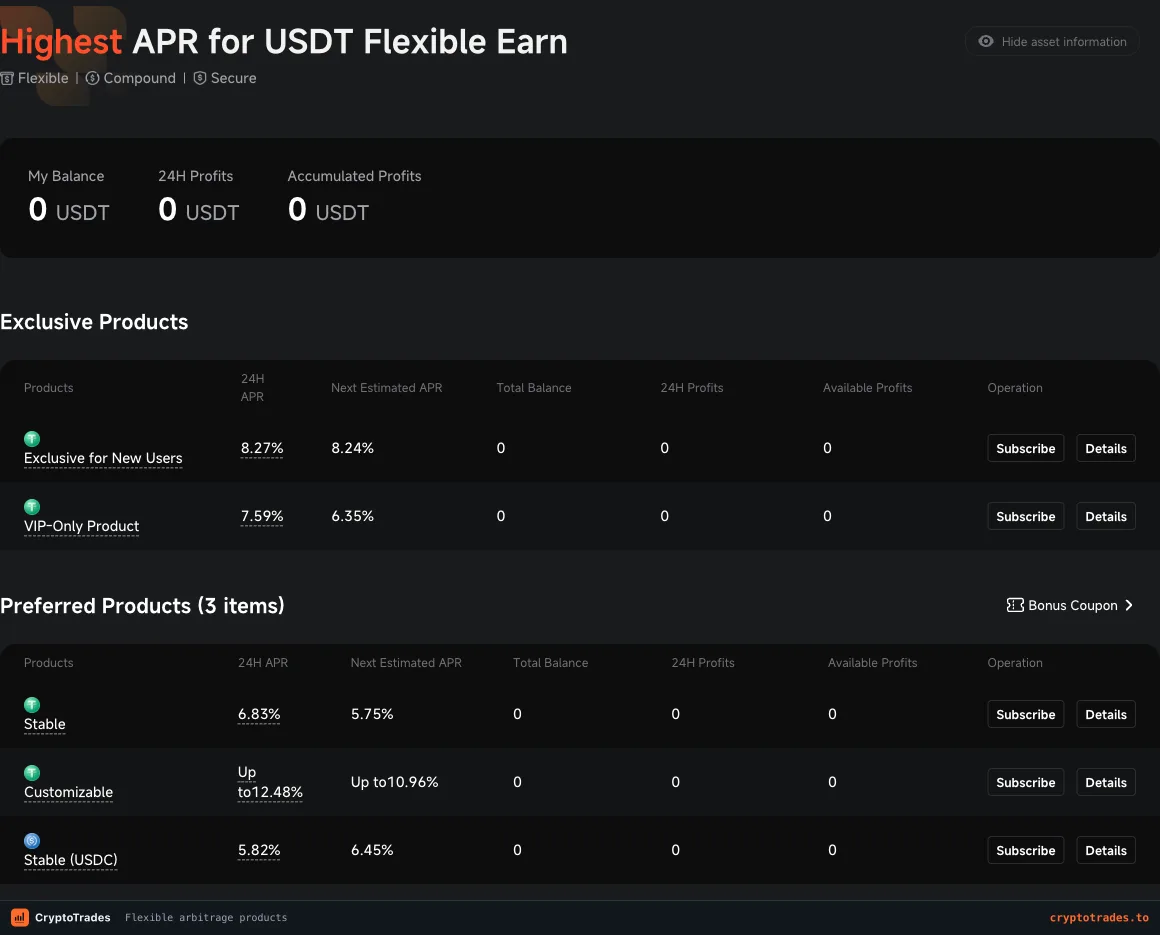
“Customizable up to” was the largest preferred-product figure on the screen. Up to is not a rate applied to every balance. Product terms, capacity and chosen parameters determine the realised result. Growth Fund products add another restriction because the promotional principal belongs to Pionex.
Deposits, withdrawals and KYC limits
Pionex publishes useful network-level minimums and fees, and our withdrawals completed in 2 to 60 minutes. Deposits credited in seconds to a few minutes. The account fee page showed daily maximums of zero at KYC level zero, 20,000 USDT at level one and 1,000,000 USDT at level two.
The live table separated minimum deposit, minimum withdrawal and withdrawal fee for every network. Bitcoin could be deposited and withdrawn over the native network or BNB Smart Chain. USDT included Tron, Ethereum, BNB Smart Chain, Arbitrum, Avalanche, Optimism, Plasma, Solana and TON in the captured table.
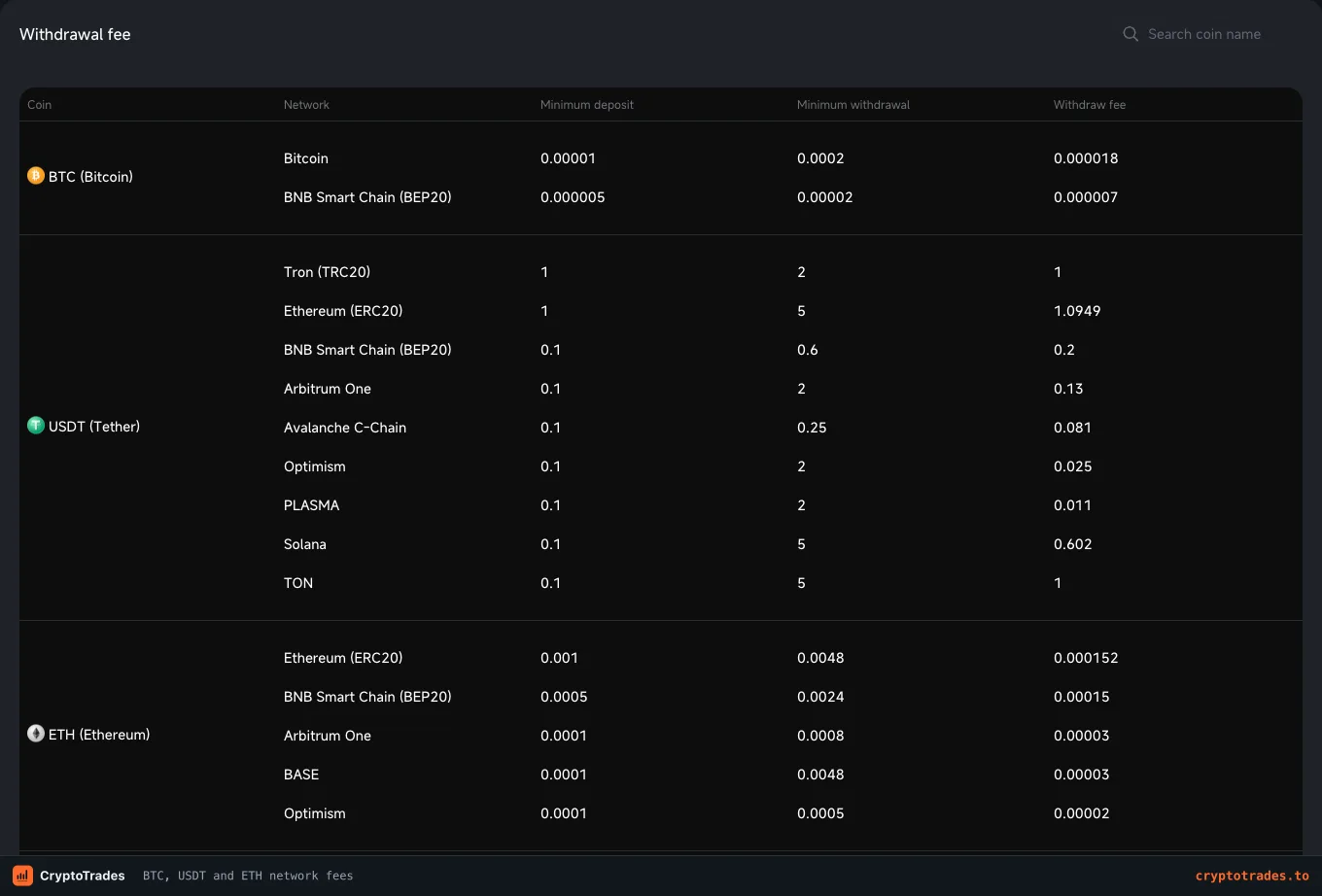
An ERC-20 USDT withdrawal was materially more expensive than several rollup or alternative-network routes at the verification moment. Cheap is useful only when the receiving wallet supports exactly the same network. Sending to the wrong chain can cost the whole transfer.
Account security is stronger than the reserve disclosure
The account controls are comprehensive. The security page offered passkeys, login password reset, email and mobile verification, an authenticator, anti-phishing code settings and login-device management.
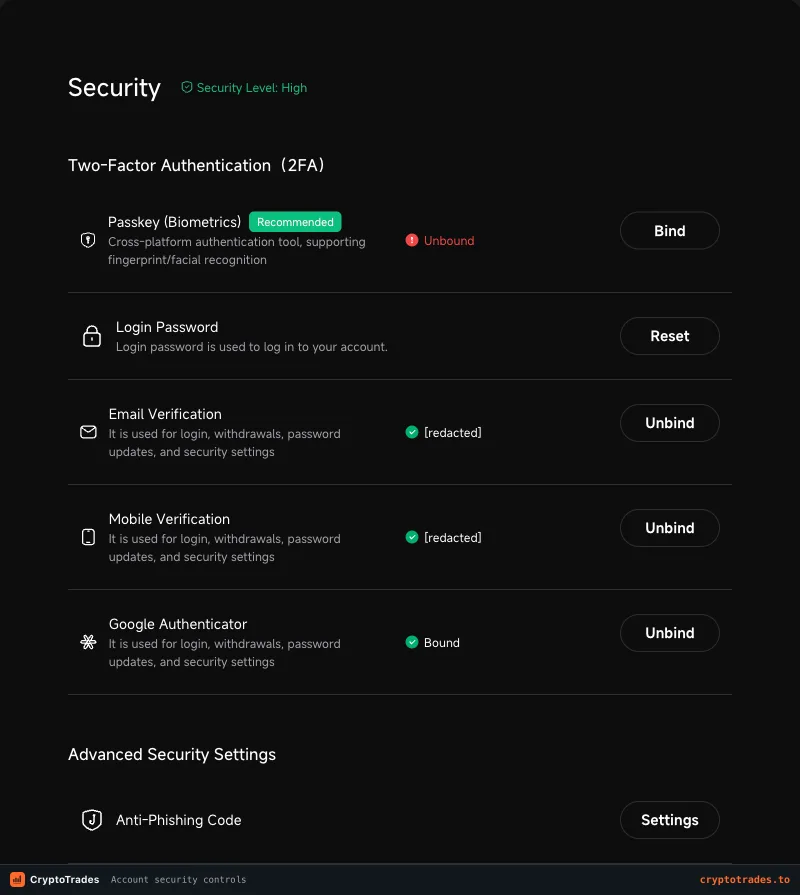
These controls reduce account-takeover risk. They do not prove how the exchange holds customer assets or whether liabilities are fully backed. Account security, custody and solvency are separate questions.
The proof-of-reserves evidence is stale
Pionex did not expose a current reserve dashboard during this investigation. Its help material points to third-party agreed-upon procedures performed on a snapshot taken in December 2022.
The report says the in-scope client liabilities represented 79.60% of total platform liabilities. It tested BTC, ETH, USD and stablecoin balances, reconciled a Merkle root and sampled ten hashed user IDs. That is more informative than no external work, but it is not complete current proof of every customer liability.
A useful new publication would show current asset balances, current customer liabilities, coverage by asset, wallets, the treatment of borrowed funds and a way for each customer to verify inclusion. Until then, the reserve disclosure is Pionex’s weakest trust signal.
Who Pionex is best for
Pionex best suits an active trader who wants exchange-native automation and understands the strategy before selecting a preset. Spot Grid, Rebalancing and TWAP are the cleanest starting points because they avoid perpetual liquidation. The 0.05% spot fee makes frequent small executions less expensive than at many large venues.
It is a poor fit for someone seeking passive guaranteed returns, a cash signup bonus or a simple regulated broker relationship. It is also the wrong place to learn leverage through an AI preset. The interface can configure a complex strategy faster than a new trader can understand its loss path.
Pionex pros and cons
The strongest advantages are the integrated builders, low spot fee, broad enabled market set and unusually clear network-fee table. The biggest weaknesses are the stale reserve evidence, regional fragmentation and marketing numbers that annualise short backtests or present temporary promotional principal as a large reward.
The bots are real tools. The headline returns are not evidence that the tools make money.
The verdict
Pionex is the strongest bot-first exchange interface we have inspected, but not the strongest exchange trust package. A trader choosing it specifically for Spot Grid, Rebalancing, TWAP or carefully bounded automation gets a coherent product and a very competitive fee. That is enough to make it worth considering.
Keep the balance proportional to the strategy. Ignore annualised AI backtests, calculate the full Martingale ladder before opening DCA, and treat Growth Fund as a short promotional yield base rather than cash. Most importantly, do not let passkeys and a polished bot screen substitute for current reserve evidence.
The rating can rise after a fresh comprehensive reserve publication and funded bot testing. For now, 4.0 reflects excellent tools, excellent fees, successful money movement, a very fast measured support response and a material unresolved custody-disclosure gap.
Where Pionex does not accept traders
Mainland China, Hong Kong, United States on Pionex Global, Singapore, Afghanistan, Cuba, Iran, North Korea, Syria, United Kingdom, Canada, Netherlands, Spain, France.
Taken from the venue's own terms. Restrictions change; check before you deposit.
Pionex questions traders actually ask
01Is Pionex legal in the USA?
Pionex Global excludes the United States. The US-facing business became Webot and is operated by Pionex Inc., a Delaware company, with its own agreement, licences, fees and product set. US residents should use the US product only where it is licensed rather than opening a Global account through a VPN.
02How safe is Pionex?
Pionex offers passkeys, authenticator verification, anti-phishing codes and device management, but its public reserve evidence is stale. The linked third-party procedures assessed a December 2022 snapshot and covered 79.60% of platform liabilities. That is useful historical evidence, not current proof that every customer liability is backed today.
03What country is Pionex from?
There is no useful one-country answer. Pionex Global's terms name Marketa Trading Inc.; the US agreement names Pionex Inc., a Delaware company; and the EU Webot product is run by Pionew Ireland Limited, which appears in the ESMA MiCA register. The entity serving the account matters more than the brand's origin story.
04Are Pionex bots good?
The builders are among the strongest exchange-native bot tools we have inspected because they expose range, grids, safety orders, direction, leverage and exits before capital is committed. The tool quality does not make every preset good. Spot Grid and Rebalancing have understandable loss paths; leveraged Martingale presets can lose an account quickly.
05Are Pionex trading bots really profitable?
They can be profitable when the chosen strategy matches the market, but profit is not automatic. Spot Grid needs repeated movement inside its range, Martingale DCA needs a recovery before its order ladder runs out, and futures bots must overcome fees and funding without being liquidated. Pionex's backtest APR is not a forecast.
06How much profit can a Pionex Futures Grid trader make?
There is no fixed return. The result depends on range, grid spacing, direction, leverage, funding, fees and the price path. A bot can show positive grid profit while its open futures position has a larger loss. Short backtests annualised into triple- or four-digit APRs should not be used as expected returns.
07What is the most successful Pionex AI trading bot?
No Pionex bot is consistently the most successful across market conditions. Spot Grid fits sideways movement, Rebalancing fits a multi-asset basket, and Futures Grid adds directional leverage. Ranking them by the largest displayed backtest APR selects the shortest and riskiest recent setup rather than a durable strategy.
08Which crypto trading bots does Pionex offer?
The current web product exposes Spot Grid, Martingale DCA, Rebalancing, TWAP, spot-futures arbitrage, Margin Grid, Reverse Grid, Infinity Grid, Signal Bot, Futures Grid, Futures DCA, COIN-M Grid and Cross Margin Futures Grids, plus trailing and smart-order tools. Availability differs between Global and regional products.
09What are the Pionex withdrawal fees?
Withdrawal fees depend on both asset and network. Pionex publishes separate minimum deposit, minimum withdrawal and fee columns for each route. USDT over Ethereum cost materially more than several alternative networks when checked, but the receiving wallet must support the exact selected network.
10What is the current promo code for Pionex?
CryptoTrades uses referral code 0NBG5CNT7yT for eligible Pionex Global registrations. A referral code does not turn the advertised Growth Fund into cash: promotional principal cannot be withdrawn, qualifying tasks and regional eligibility still apply, and only generated profit can become withdrawable.
11Does Pionex charge for its trading bots?
Pionex does not show a separate subscription price for its built-in bots. The cost comes from the orders they execute: regular global spot trades cost 0.05% per side, futures trades cost 0.02% maker or 0.05% taker, and perpetual bots can also pay funding. Spread and withdrawal fees are additional.
Reviewed by CryptoTrades.to
Independent crypto research and market-data team. CryptoTrades.to is a pseudonymous group of crypto specialists active in the market since 2015. The group focuses on Bitcoin, exchange products, market structure and custody risk, and includes a trader with 15 years of market experience. Team members remain anonymous because connecting public identities to cryptocurrency activity and holdings can create personal-security risks.
Scoring method: how we rate an exchange.