
How we scored it
Bybit is a large derivatives venue with deep perpetual liquidity, 150x leverage and cheap contract fees. It also lost roughly 1.5 billion dollars of customer Ethereum to a state-sponsored attack and paid every withdrawal through it, which is the single most important thing to understand before depositing.
- Cost
- Maker fee
- 0.100%
- Sign-up offer
- Advertised as up to 100 USDT in welcome bonuses.
- Trading
- Products
- spot, perp, futures, options, bots, copy, earn
- Assets listed
- 400
- Access
- Identity verification
- tiered
- Fiat deposits
- Yes
- Company
- Founded
- 2018
- Headquarters
- Dubai, United Arab Emirates
- Proof of reserves
- Published
First reply arrived in 3 to 5 minutes on all four tickets we opened. That is fast for this industry, where a first response measured in hours is normal.
- Perpetual fees of 0.055% taker, 0.02% maker. Less than half the spot rate and competitive with anything we track.
- 804 perpetual and 546 spot markets in our own database, the widest derivatives coverage of any venue we collect from.
- Perpetuals on Tesla, Nvidia and gold, margined from the same balance as the crypto contracts.
- Publishes what almost nobody does: live per-asset transfer status, the insurance fund balance daily, and per-contract auto-deleveraging thresholds.
- Withdrawals landed in 2 to 60 minutes and support answered four tickets in 3 to 5 minutes each, both measured by us.
- Paid every withdrawal through the worst exchange breach on record, which is a stronger solvency signal than any marketing claim.
- Lost roughly 1.5 billion dollars of Ethereum in a cold-wallet breach, the largest crypto theft ever recorded.
- Europeans get a different, smaller platform: spot only, no derivatives at all, at two and a half times the global taker fee.
- Headline numbers are engineered. A 555% Earn APR that runs two days, a 155% bot APR from an eight-day backtest, a 1025 USDT referral that tops out in a lottery ticket.
- A Futures Martingale bot sold as "recover quickly from losses", with no risk warning beside it.
- The 0.1% spot fee is ordinary, and only improves at volume tiers most accounts will never reach.
Two Bybits, and which one you get is decided by where you live
Before anything else, because almost every review of this venue misses it and it changes the answer completely: Bybit is two different companies. The global platform at bybit.com is the one everybody writes about. European users are routed to Bybit EU, a separately regulated MiCAR entity, and it is a materially smaller product.
| Global | Bybit EU | |
|---|---|---|
| Products | Spot, perpetuals, dated futures, options, TradFi contracts | Spot and spot margin only |
| Maximum leverage | 150x | 10x |
| Entry taker fee | 0.100% | 0.250% |
| Entry maker fee | 0.100% | 0.100%, rising to 0.250% in October |
| Main quote asset | USDT | USDC, with EUR and PLN pairs |
| Identity verification | Tiered | Part of onboarding |
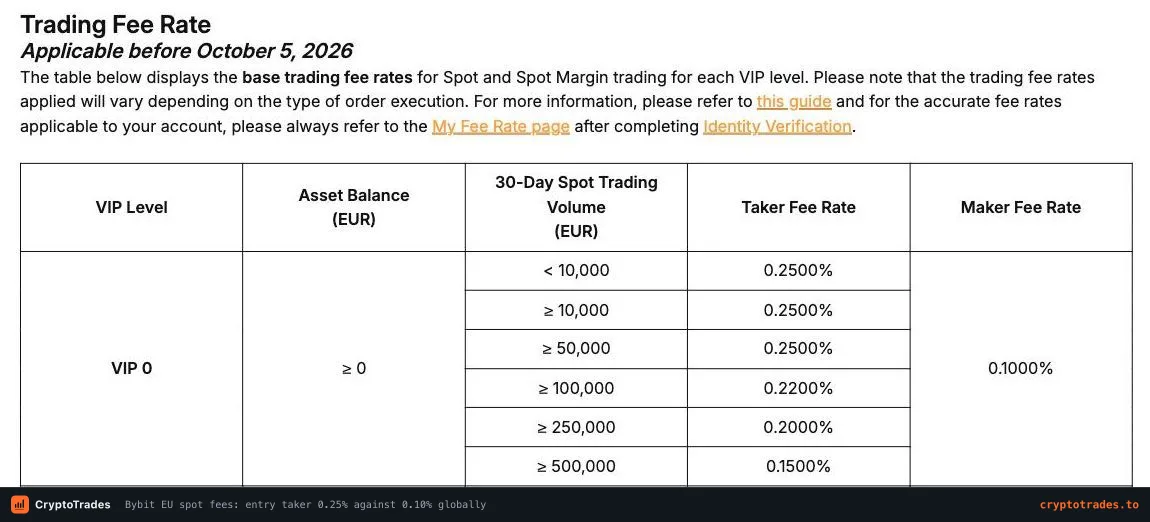
The product gap is larger still. Everything below about perpetual fees, funding and 150x leverage describes the global platform. In the EU none of it exists. If you are in Europe and came here for leverage, this venue does not offer it to you, and no amount of reading about its perp book will change that.
Who the global platform suits
Bybit is a derivatives venue that also runs a spot market, and the balance of the product shows it. The perpetual fee is less than half the spot fee, contract coverage is the widest of any venue we collect from, and the leverage ceiling is higher than most competitors offer. For perpetual trading it is a serious venue. For simple spot buying you are paying 0.1% for a platform built around something else.
What the fees actually cost
At the entry tier the global spot rate is 0.1% on both sides. A round trip on a 10,000 dollar position is 20 dollars, ordinary for a large venue and roughly double the cheapest.
The contract side is where it gets interesting. At 0.055% taker and 0.02% maker, the same round trip costs 7.50 dollars taking both sides, or 4 dollars posting both as maker orders. Those are competitive, and they are what most of Bybit’s volume actually pays.
Tiers move on balance or 30-day volume, whichever qualifies you higher, and refresh daily. The first meaningful step needs 100,000 dollars of assets or a million in monthly volume, so most retail accounts stay at entry permanently. Compare the entry rate, not the tier table, because the tier table is not describing you.
Liquidity, measured rather than claimed
Our collector reads Bybit directly. As of the last cycle we track 804 perpetual contracts and 546 spot markets there, covering 400 distinct assets, the widest derivatives coverage in our database.
On the majors that depth shows in our composite: Bybit’s Bitcoin print sits within a few dollars of the volume-weighted average across every venue we track. A venue whose price agrees with everyone else’s is one where your order is unlikely to be the thing that moves the market. Current picture on our Bitcoin page, and funding compared across venues on the funding rates page.
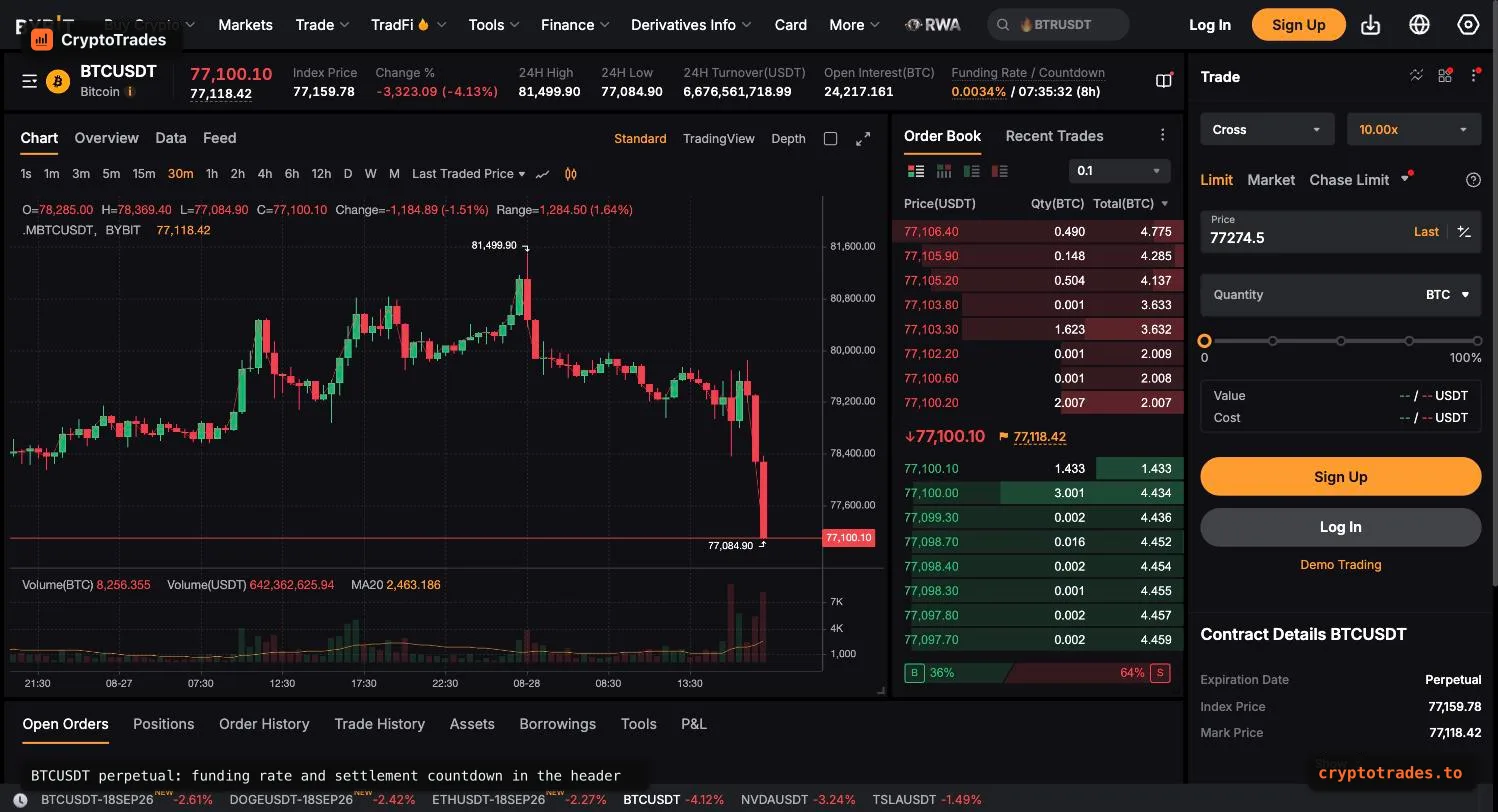
The perpetual screen puts the funding rate and the countdown to the next settlement in the header, which is the right place for them. Most venues bury both.
Perpetuals on Tesla, Nvidia and gold
The most distinctive thing on the platform, and the least covered. Alongside crypto, Bybit lists perpetual contracts on traditional assets: Tesla, Nvidia, semiconductor and gold contracts among others, margined in USDT from the same balance as everything else. They trade around the clock, including when the underlying market is shut.
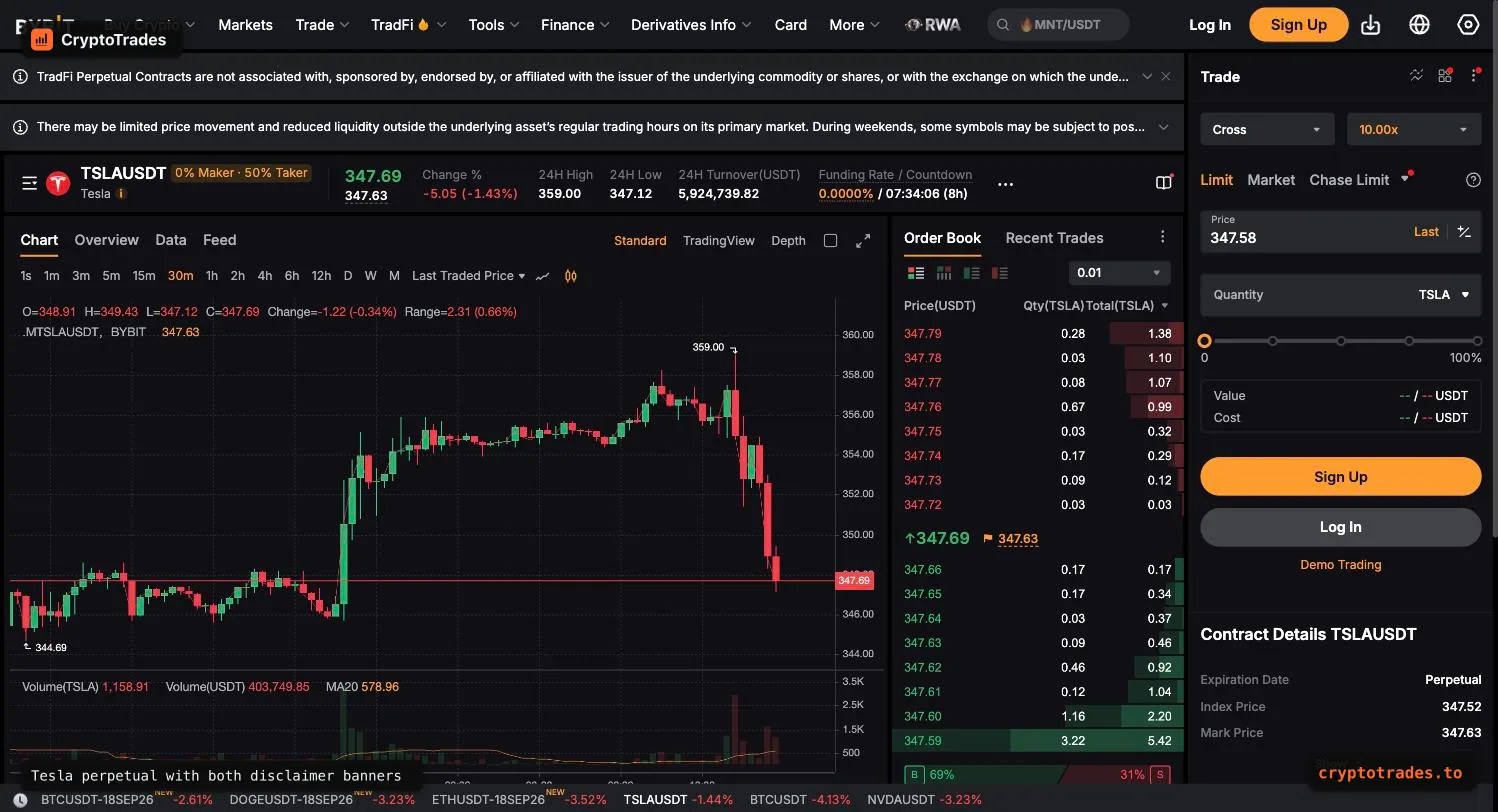
Two banners sit permanently above the order book, and both deserve reading. The first says these contracts are not associated with, sponsored by or endorsed by the issuer of the underlying share. The second says liquidity thins and price movement may be limited outside the underlying asset’s own trading hours.
That second one is the practical warning. A Tesla perpetual at three in the morning is a contract referencing a market that is closed, priced by whoever is awake on this venue. The instrument works, and it is genuinely useful for anyone who wants equity exposure without a broker. It is not the same thing as owning the share, you have no shareholder rights, and the thin-hours behaviour is real.
Copy trading, and the number they show that others do not
The copy trading product is large: north of 800,000 followers and half a billion dollars in realised profit by its own counter.
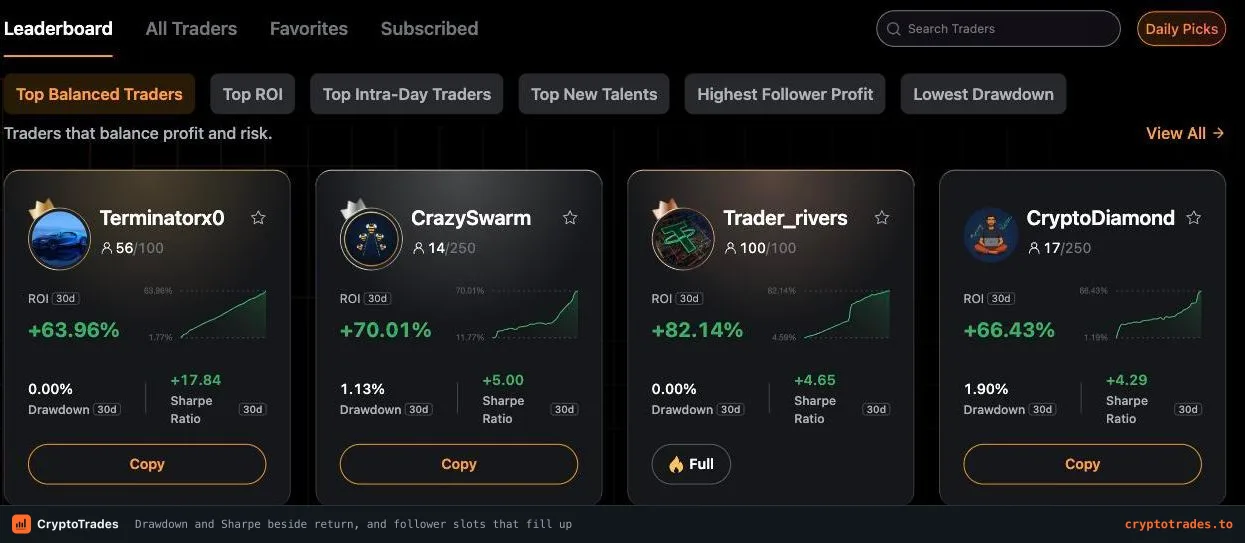
What makes it better than most is the filtering. Traders can be ranked by lowest drawdown as well as by return, and follower slots are capped per trader, so a popular account cannot absorb unlimited money into strategies that stop working at size.
Several of the leaderboard traders show their slots already full, which is the system working as intended rather than a fault.
The bots, and the one nobody should be sold
Six bot types, and the lineup itself tells you who they are for.
Spot Grid buys low and sells high inside a range you set, pitched at sideways markets. Futures Grid does the same with leverage, pitched at volatile ones. Futures Combo and the new TradFi Combo run auto-rebalancing portfolios, the second across the stock and commodity contracts. DCA buys on a schedule, badged as flexible savings. All reasonable, all standard.
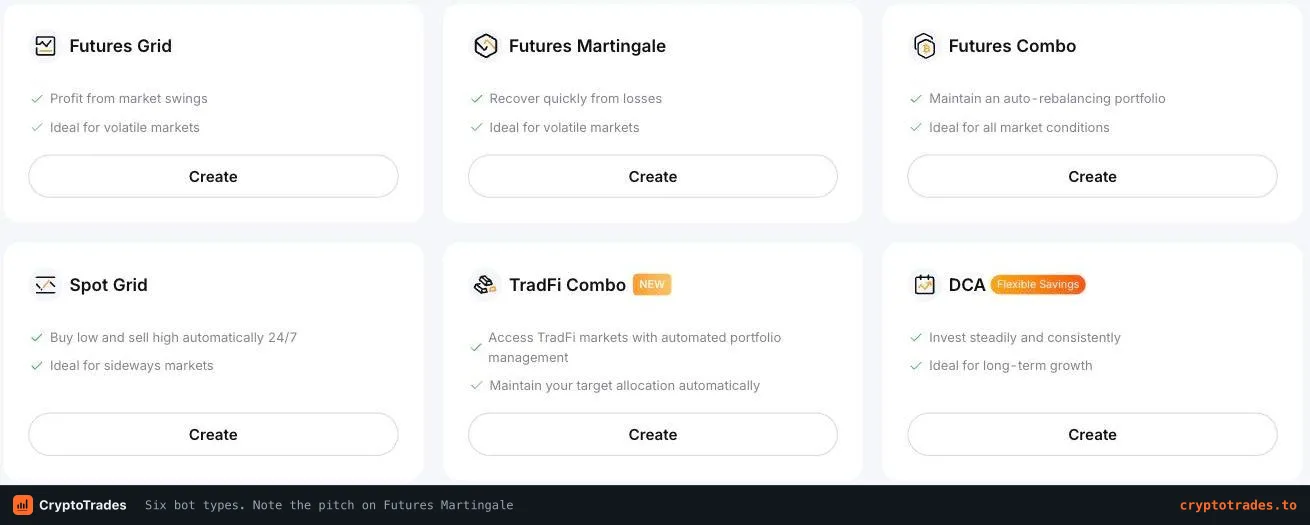
Then there is Futures Martingale, and its selling line is “recover quickly from losses.”
A martingale increases position size after each loss so that one eventual win recovers everything before it. It works until it does not, and when it does not it takes the whole account, because the position size needed to recover grows geometrically while the balance funding it does not. Applying that on leveraged futures, where liquidation arrives before the losing streak ends, is the most reliable way to lose everything that this platform offers. Selling it as loss recovery inverts what it actually is.
The backtest numbers are not returns
Below the bot picker sits an AI-branded zone of “backtest recommendations,” each with a headline APR. On the day we looked: a DOGE futures grid at short 3x showing 155.91% APR, a LINK spot grid at 31.15%, an XRP spot grid at 34.68%.
Read the small print on the same cards.
The genuinely useful part is that Bybit publishes drawdown and volatility next to the return instead of the return alone, which is more than most bot marketplaces do. Use those two columns. Ignore the big green number.
Bybit Earn, and the 555% that is not a yield
The Earn page is fronted by a 555% APR on USDT. The duration is two days, and products like it are normally capped at a small subscription amount. Annualising a two-day promotional rate produces a number no balance will ever earn over a year, and setting it in the largest type on the page is a choice.

The rates that describe holding money here are underneath: stablecoin products between roughly 3% and 10%, a 10% three-day Bitcoin product, and an RWA product around 16%. Those are fine, ordinary numbers. The headline is marketing.
What the bonuses actually pay
The headline is “up to 100 USDT in Welcome Bonuses.” Opening the Rewards Hub shows what that means, and it is worth spelling out because the structure is the point.
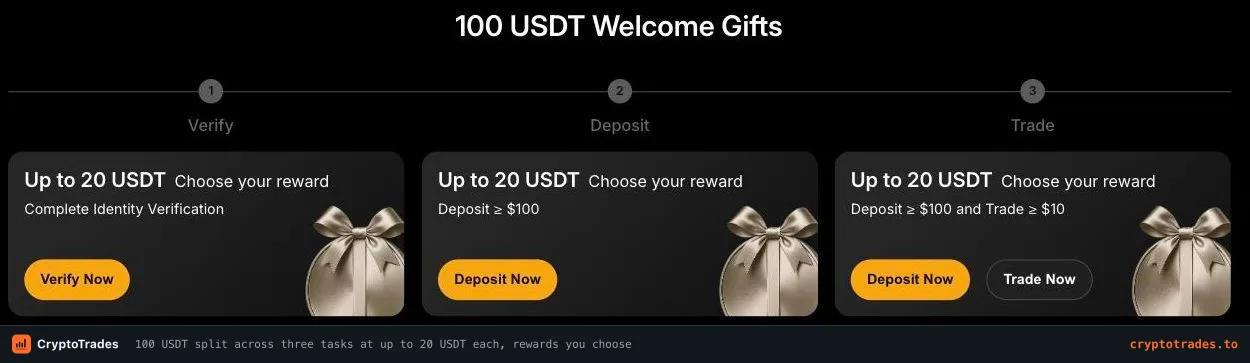
The welcome offer is split across tasks, each worth up to 20 USDT, and each asks you to choose your reward from a set rather than paying cash:
- Complete identity verification
- Deposit at least 100 dollars
- Deposit at least 100 dollars and trade at least 10 dollars
“Up to” is doing real work in those lines. So is “choose your reward”: the rewards are coupons and discounts, not a balance credit, so a 20 USDT ceiling can arrive as a fee discount you only realise by trading enough to consume it.
The referral programme is built the same way, and more steeply. It advertises 1025 USDT. The tiers we saw:
| Reward | What it takes |
|---|---|
| Up to 10 USDT | Deposit 100 USDT, within a 7-day window |
| Up to 15 USDT | Deposit 100 USDT and trade 500 USDT |
| One chance | Deposit 100 USDT and trade 10,000 USDT |
None of this is unusual and none of it is hidden: the conditions sit on the page in plain sight, with progress bars showing exactly how far along you are. But the distance between “100 USDT welcome bonus” as it appears in advertising and a set of capped coupons unlocked by verification, deposit and volume is large enough that it should be stated before you open an account rather than after.
Getting money in
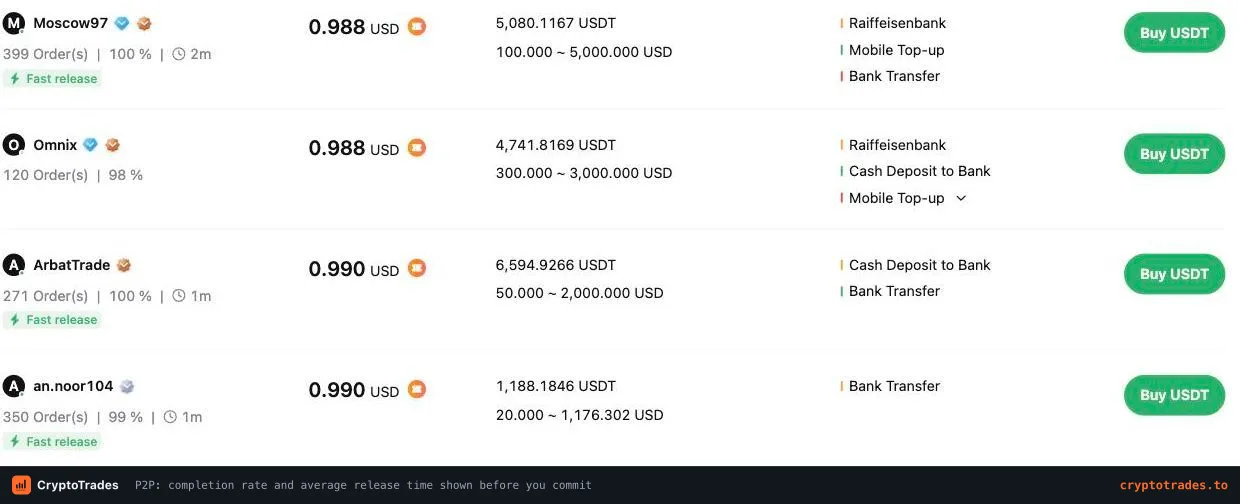
The P2P marketplace charges no platform fee, covers 60 or more fiat currencies and over 100 payment methods, and shows each advertiser’s completion rate and average release time before you commit. That last detail is what makes a P2P book usable, and it is the right thing to check before picking a counterparty rather than sorting purely on price.
Be careful with the sort order. The cheapest advertisement is not reliably the best one, and an offer priced conspicuously away from the market is a reason to look harder rather than to click faster.
Getting money out, and the page nobody links to
Withdrawal costs are where comparison sites usually give up and write “varies by asset.” Bybit does publish them, but not on a fee page. They sit inside an expandable row on a status page reached through a footer link called Fees and Transactions Overview, and the help centre’s own AI assistant, asked directly about withdrawal fees, answers that they vary and suggests looking in the withdrawal screen.
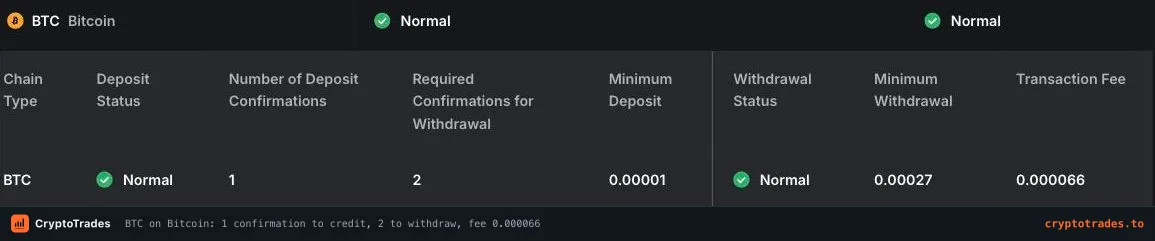
Expand a row and the detail is genuinely good. For Bitcoin on the Bitcoin network, on the day we checked:
| Withdrawal fee | 0.000066 BTC when we looked, around five dollars. It moves with network conditions |
| Minimum withdrawal | 0.00027 BTC |
| Minimum deposit | 0.00001 BTC |
| Confirmations to credit a deposit | 1 |
| Confirmations required before withdrawal | 2 |
Crediting a Bitcoin deposit after a single confirmation is faster than most venues, which typically want two or three. The fee is mid-market. None of this is hidden, exactly, but burying per-asset withdrawal costs two clicks deep inside a status table is a choice that makes the platform look cheaper than it is at a glance.
The same page tells you what is broken right now
The more useful half of that table is the live status column, and it is the thing no static review can give you. On the day we looked, Ethereum and Tether were both showing Limited Service on deposits and withdrawals, USD Coin was limited on withdrawals, Mantle was limited on withdrawals, and one listed token had deposits suspended outright.
Limited Service usually means one network for that asset is paused while others work, often during a chain upgrade or a congestion event, and it usually clears. It is not evidence of anything sinister. But it does mean that on an ordinary Thursday, three of the most-moved assets on the platform were in a degraded state, and the only way to know before starting a transfer is to check this page.
Bookmark it. Check it before a deposit and before a withdrawal, especially if you are moving stablecoins. That advice applies to every exchange; Bybit is simply one of the few that publishes the status openly enough to act on.
How much platform there actually is
Worth stating plainly, because it cuts both ways. Beyond spot and derivatives, the finance menu alone carries Easy Earn, on-chain earn, real-world-asset earn, structured products under Advanced Earn, crypto loans, a bespoke lending desk, margin-borrowed staked SOL, a payment card, a peer-to-peer payments product, an OTC desk and a private wealth management arm. The tools menu adds six bot types, copy trading and demo trading. There is a launch platform, a community feed, a learn hub and a wallet.
For an experienced trader who wants one account for everything, that breadth is the argument for using Bybit. For someone opening a first exchange account, it is a lot of surface area between them and the two things they came to do, and much of it carries a campaign banner. Which of those two readers you are determines whether the size of this platform is a feature.
If you trade through an API
The API is a genuine strength and gets less attention than it should. It covers spot, derivatives and options, and there is an established third-party ecosystem built on it, with named broker integrations for the usual professional tooling. Our own collector reads Bybit’s public endpoints every cycle without an account or a key, and the data comes back clean, complete and correctly typed, which is not true of every venue we pull from.
One caveat from building against it: the linear category returns perpetuals and dated futures together, and only the contract type field separates them. Anything comparing prices across venues has to filter on that or it will quietly mix a June contract’s basis into a spot comparison. We know because we made exactly that mistake.
The VIP ladder
Tiers advertise up to 55% off fees plus airdrops and card cashback, and there is a promotion offering a two-level jump. The thresholds are the thing to check before treating any of it as relevant: the first meaningful tier wants 100,000 dollars of assets or a million dollars of monthly volume. For the overwhelming majority of accounts the entry rate is the rate, permanently, and the ladder is decoration.
The withdrawal complaints, and what is actually behind them
Search for a review of this venue and the highest-ranking result is not a review. It is a Trustpilot page carrying a score around 2.6 out of 5 across roughly eight thousand ratings, and a second Trustpilot page for the European entity sits a few places below it with the same theme. Underneath those, a Reddit thread asking whether the platform can be trusted. The affiliate reviews that do rank lead with sign-up bonuses.
Start with the base rate: exchange review scores skew heavily negative everywhere, because a person who withdraws successfully does not write a review and a person whose transfer is stuck at midnight does. A 2.6 is not evidence of fraud. It is also not nothing.
From working through the platform, three mechanisms explain most stuck-withdrawal reports, and all three are checkable before you deposit rather than after:
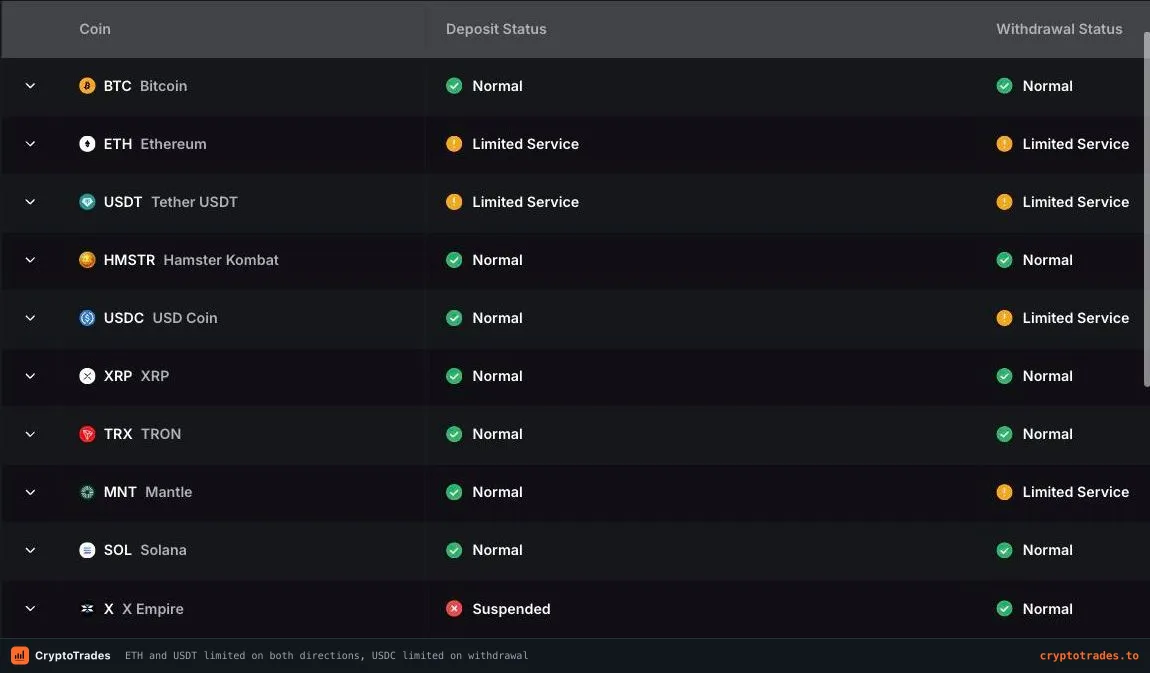
The asset is degraded. Bybit publishes live per-coin, per-network deposit and withdrawal status. On an ordinary day during our research, Ethereum and Tether were both in Limited Service on deposits and withdrawals, and USD Coin was limited on withdrawals. A trader hitting that without knowing the page exists experiences it as a frozen withdrawal. It usually reflects one network paused during an upgrade, and it clears.
The account is under-verified. Withdrawal capability is tiered against identity verification, and the tier that matters is often discovered at the moment of withdrawing rather than at signup.
The withdrawal is in security review. Standard after a password change, a new 2FA device or a new withdrawal address, and standard across the industry.
None of that makes every complaint invalid, and a venue that suffered a 1.5 billion dollar breach has earned scrutiny about how it handles customer money. But the gap between “this exchange is a scam” and “this asset is in limited service on the network I chose” is wide, and it is a gap nobody currently ranking bothers to close.
Our own withdrawals landed between 2 and 60 minutes. That is a wide range, and the wide end is the point: the slow withdrawals coincided with an asset sitting in limited service, which is the first mechanism above rather than a separate problem. Deposits credited in seconds to a few minutes, following the chain rather than the exchange.
Support answered four tickets in three to five minutes each. For an industry where a first response measured in hours is normal, that is fast, and it matters here specifically: someone whose withdrawal is stuck at midnight because USDT is degraded needs an answer that night, not the next afternoon.
The breach, in full
In February 2025 an attacker drained roughly 1.5 billion dollars of Ethereum from a Bybit cold wallet, the largest cryptocurrency theft ever recorded. The attack did not break the cryptography. It manipulated what the signers saw: the interface displayed a legitimate destination while the underlying contract logic had been altered, so authorised humans approved a transaction that did something other than what their screens showed. The FBI attributed it to the Lazarus Group, working for North Korea.
What happened next matters more for anyone deciding where to keep money. Bybit stayed open. Withdrawals kept processing through the worst possible week for an exchange. The shortfall was covered and customer balances remained backed one to one. Within a month most of the stolen ETH had been laundered into Bitcoin and is effectively gone.
Our security score reflects both. Not high, because it happened. Not disqualifying, because the response was close to the best available.
Proof of reserves, and the insurance fund
This is the area where Bybit is genuinely better than most, and it is worth being precise because we got it wrong on a first pass and had to correct ourselves.
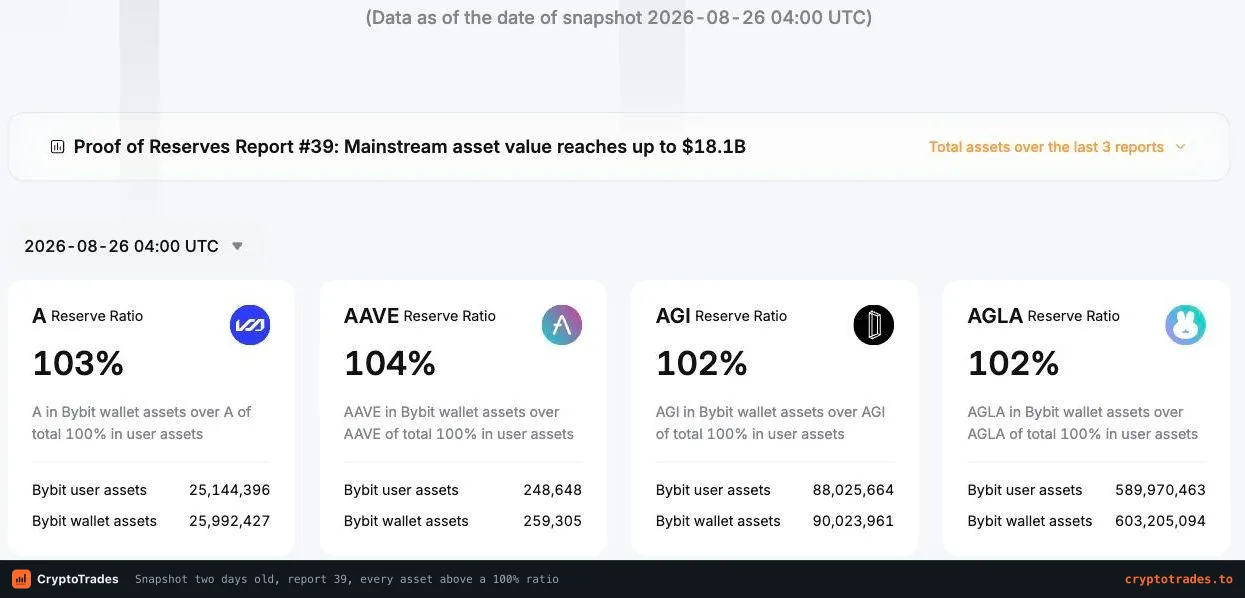
The reserve ratio page carries a snapshot two days old at the time we checked, from Proof of Reserves report number 39, covering 18.1 billion dollars of mainstream assets. Every asset we looked at showed a ratio above 100%: 103% for one, 104% for another. The underlying method is a Merkle tree with third-party audit reports, and Bybit publishes the verification code so you can confirm your own balance was inside the audited total. Wallet ownership is proven with a send-to-self transaction from the published address.
If you look only for the audit PDFs you will find them on a slower, roughly quarterly rhythm and conclude the cadence has lapsed. That is the wrong conclusion, and it was ours until we clicked through: the ratio snapshots update far more often than the formal audit reports do.
Worth remembering what the technique can and cannot do in any case. It shows assets existed at one moment. It says nothing about liabilities held elsewhere, or about the day after the snapshot.
The insurance fund is published too
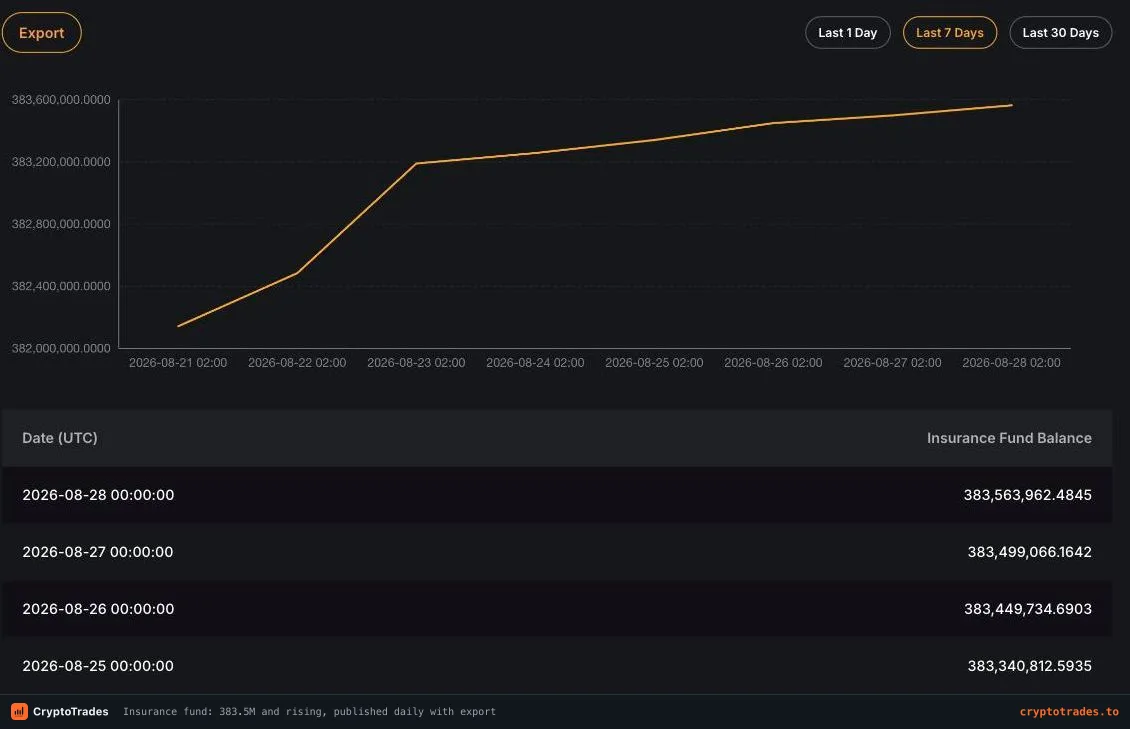
Separately, and more unusually, Bybit publishes its derivatives insurance fund balance daily with history and a CSV export. The fund stood at roughly 383 million dollars for the USDT-margined book when we looked, rising steadily across the week.
The fund exists to absorb the negative equity left when a liquidation closes worse than bankruptcy price, and it is financed from the residual margin of liquidations that close better than bankruptcy price. When it runs dry, the venue reaches instead for auto-deleveraging, which force-closes profitable traders on the other side of the book.
Bybit publishes the ADL trigger conditions per contract: the fund balance threshold, the eight-hour drawdown stop and trigger, and the current drawdown ratio, which read 0.00% across the contracts we sampled. A leveraged trader can therefore check, before opening a position, how close the venue is to deleveraging winners. Very few exchanges expose that at all, and it is a better security signal than most of what gets marketed as one.
Where you cannot use it
The excluded list is long and includes several of the largest markets in the world: the United States, Canada, Singapore, Hong Kong and mainland China, alongside sanctioned jurisdictions. Bybit also reserves the right to add jurisdictions whenever it chooses, and has exercised that right before.
Misrepresenting your location is a bad plan on any venue, because discovery usually happens at withdrawal, which is the worst possible moment.
The verdict
Outside Europe, a strong derivatives venue: cheap contract fees, deep books, the widest market coverage we track, and a genuinely unusual TradFi product, carrying a security history that deserves reading rather than skipping. For perpetual trading it earns its place.
Inside Europe, a different and much plainer proposition. Spot only, 10x at most, and a fee two and a half times higher that is about to get worse for makers. It is a competently run, regulated place to buy crypto.
It is not the exchange the rest of this page describes, and the gap between the two is the most useful thing we can tell you about it.
Where Bybit does not accept traders
United States, Chinese Mainland, Hong Kong, Singapore, Canada, North Korea, Cuba, Iran, Uzbekistan, Crimea, Donetsk, Rostov, Luhansk, Sevastopol, Sudan, Syria.
Taken from the venue's own terms. Restrictions change; check before you deposit.
Bybit questions traders actually ask
01Is Bybit exchange safe?
Bybit is solvent, publishes a 1:1 reserve ratio verified two days before we checked, and runs a 383 million dollar insurance fund it reports daily. It also suffered the largest exchange theft on record, roughly 1.5 billion dollars of Ethereum taken in a cold-wallet breach the FBI attributed to North Korea's Lazarus Group. It covered the loss, kept withdrawals open throughout and stayed backed one to one. Treat that as strong evidence about the balance sheet and weak evidence about operational security, because both readings are true.
02Why is Bybit banned in the USA?
Bybit does not hold the state and federal registrations that offering leveraged crypto derivatives to US residents would require, so rather than register it excludes the market. It is a licensing decision, not a finding against the company. The United States sits alongside Canada, Singapore, Hong Kong and mainland China on its excluded list, and using a VPN to get around it usually ends at withdrawal, when identity checks catch the mismatch.
03Can I withdraw my money from Bybit?
Yes. Our own withdrawals completed in 2 to 60 minutes, with the slow end coinciding with an asset in limited service rather than any hold by the exchange. Bitcoin withdrawals cost around 0.000066 BTC with a 0.00027 minimum and clear after two confirmations. Where withdrawals do stick, it is usually one of three checkable causes: the asset is in Limited Service on your network, your account is below the verification tier the withdrawal needs, or the withdrawal is in security review after a password or 2FA change.
04Which is better, Bybit or Binance?
Binance is larger and lists more assets; Bybit's perpetual fees are lower at the entry tier and its derivatives tooling is stronger. The honest answer depends on where you live, because both restrict heavily and both run separate regional entities with different products. Compare the version available in your country rather than the global platform either one advertises.
05Is Bybit better than Coinbase?
They are built for different people. Coinbase is regulated in the United States, accepts US customers, and charges considerably more for simple spot trades. Bybit is cheaper, offers leverage up to 150x and far more markets, and does not serve the United States at all. If you are American the question is settled for you. If you are not, Bybit costs less and does more, with a worse security history and less regulatory recourse.
06Is Bybit EU the same as Bybit?
No. Bybit EU is a separate MiCAR-regulated entity and a materially smaller product: spot and spot margin only, 10x maximum leverage, no perpetuals, no futures, no options and no TradFi contracts. Its entry taker fee is 0.25% against 0.10% on the global site, and from 5 October 2026 a single unified 0.25% rate applies to maker orders too.
07What does it cost to withdraw from Bybit?
It depends on the asset and network. Bitcoin on the Bitcoin network cost 0.000066 BTC when we checked, roughly five dollars, with a minimum withdrawal of 0.00027 BTC. The figure moves with network conditions, so treat it as a range rather than a fixed price. Per-asset figures are published inside an expandable row on the deposit and withdrawal status page rather than on any fee page, which is why most people never find them.
08What is the maximum leverage on Bybit?
150x on the major perpetual contracts including Bitcoin and Ethereum, read directly from the venue's public instruments data. Smaller contracts carry lower limits, and European users are capped at 10x because the EU entity offers no derivatives at all.
09Is Bybit Earn's 555% APR real?
The rate is real and the duration is two days, usually on a capped subscription amount. Annualising a two-day promotional rate produces a headline no balance will ever earn over a year. The rates that describe holding money at Bybit are the stablecoin products underneath, roughly between 3% and 10%.
10Does Bybit publish proof of reserves?
Yes, and more often than the audit PDFs suggest. The reserve ratio page carried a snapshot two days old when we checked, from report number 39, with every asset above a 100% ratio. It uses a Merkle tree with third-party audits and publishes the verification code so you can confirm your own balance was included. It shows assets at a point in time and says nothing about liabilities elsewhere.
11Can you trade stocks on Bybit?
Yes, as perpetual contracts rather than shares. Bybit lists TradFi perpetuals on names like Tesla and Nvidia plus commodities including gold, margined in USDT from the same balance as the crypto contracts. You never own the underlying, you have no shareholder rights, and Bybit's own banner warns that liquidity thins outside the underlying market's regular hours.
Reviewed by CryptoTrades.to
Independent crypto research and market-data team. CryptoTrades.to is a pseudonymous group of crypto specialists active in the market since 2015. The group focuses on Bitcoin, exchange products, market structure and custody risk, and includes a trader with 15 years of market experience. Team members remain anonymous because connecting public identities to cryptocurrency activity and holdings can create personal-security risks.
Scoring method: how we rate an exchange.